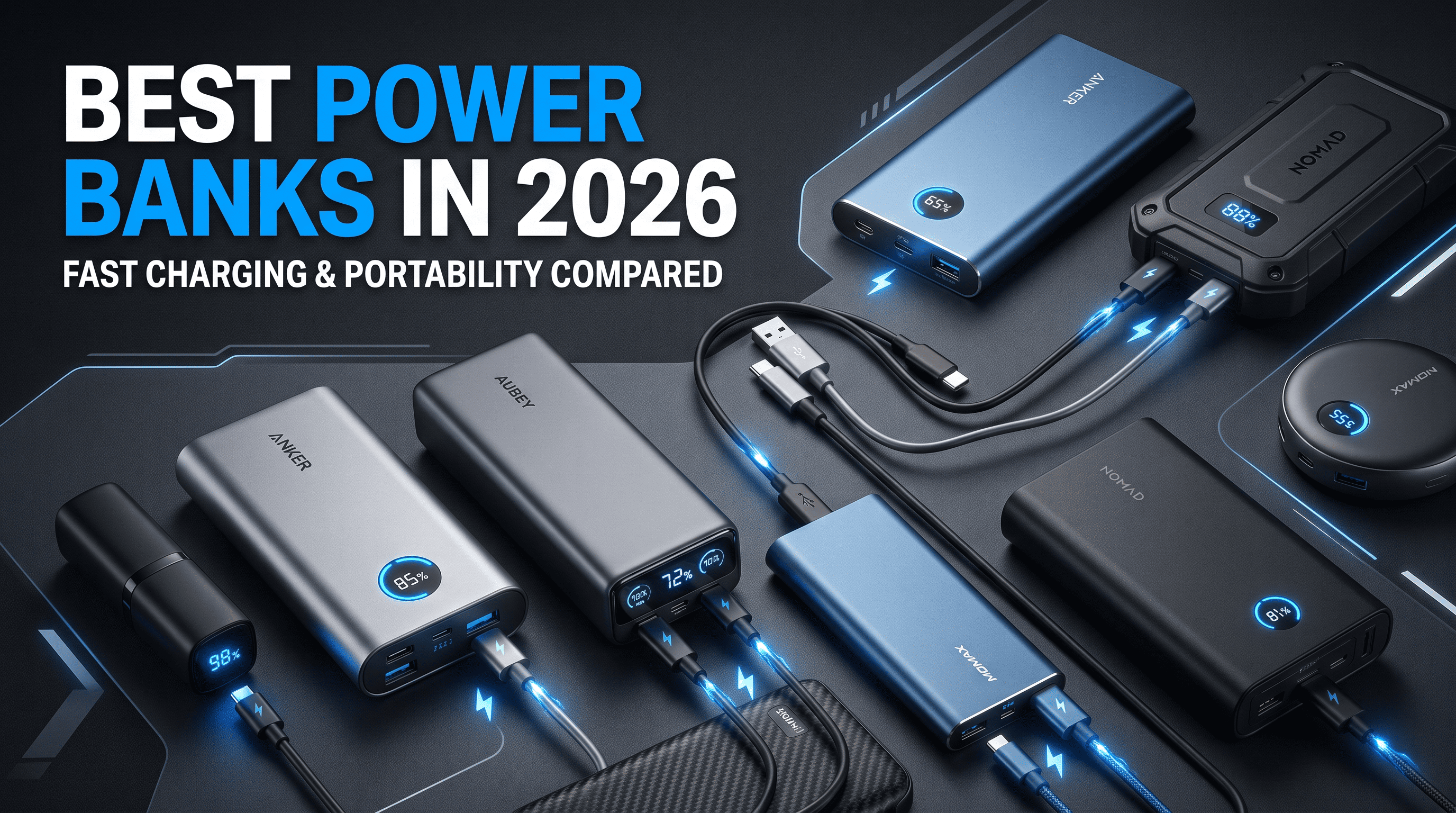
Best Power Banks in 2026 | Fast Charging & Portability Compared
Introduction
Power banks have quietly become one of the most essential tech accessories of 2026. As phones, tablets, laptops, and even smart glasses draw more power from denser batteries, having reliable backup charging on hand is no longer optional for anyone who spends a full day away from an outlet. Market data shows portable power banks and phone chargers in a strong, sustained upward trend in both search interest and sales volume -- this isn't a fad category, it's a staple.
At 9Smart, we break down what actually matters when choosing a power bank in 2026, compare the top contenders by category, and help you avoid overpaying for capacity you'll never use.
Why Power Banks Matter More in 2026
Two shifts are driving demand this year. First, devices themselves have gotten power-hungrier -- larger phone screens, always-on smartwatches, and AI-assisted features running in the background all drain batteries faster than a few years ago. This same rising power demand is also why smartphone overheating has become a more common complaint. Second, fast-charging standards have matured, meaning a good power bank today can refill a phone to 50% in under 20 minutes, making a quick top-up genuinely useful instead of a slow inconvenience.
What to Look for Before Buying
1. Capacity (mAh) -- Match It to Your Actual Use
More capacity isn't automatically better; it usually means more weight and bulk.
- 5,000-10,000 mAh: Ideal for topping up a phone once or twice. Best for light daily carry.
- 10,000-20,000 mAh: A solid middle ground -- enough for a full weekend trip or multiple device charges.
- 20,000 mAh+: Best for laptop charging, extended travel, or camping where you have no access to outlets for days.
2. Output Wattage and Fast-Charging Support
Check whether the power bank supports the USB-C Power Delivery standard and at what wattage. A bank rated for 65W+ can charge a laptop, not just a phone -- a key difference many buyers overlook.
3. Number and Type of Ports
If you're charging multiple devices at once (phone, earbuds case, smartwatch), look for at least two output ports, ideally one USB-C and one USB-A for backward compatibility.
4. Pass-Through Charging
This lets you charge the power bank itself while it simultaneously charges a connected device -- useful for anyone using their power bank as a permanent desk or travel hub.
5. Safety Certifications
Look for UL or CE certification, and avoid unbranded models with no listed safety testing -- battery packs are one accessory category where cutting corners can genuinely be dangerous.
Top Power Bank Picks by Use Case
Best for Everyday Carry
A slim, 10,000 mAh model with USB-C PD is the sweet spot for most people -- light enough to forget it's in your bag, but strong enough for a full phone recharge plus extra.
Best for Frequent Travelers
Look for 20,000 mAh+ models with dual fast-charging ports and airline-compliant battery ratings. Most airlines follow TSA guidance on carrying lithium batteries, which caps carry-on power banks at 100Wh without special approval -- so check the label before you fly.
Best for Laptop Users
Prioritize models rated 65W or higher with USB-C PD 3.0 support, ideally with a digital display showing remaining charge percentage rather than a vague four-LED indicator.
Best Budget Option
Mid-range 10,000 mAh banks from established brands now offer fast charging at a fraction of the price of premium models -- a good choice if you mainly need backup power for emergencies rather than daily heavy use.
Best for Outdoor and Camping Use
Solar-compatible power banks with rugged, water-resistant casings are worth the extra cost if you're regularly off-grid, though don't expect solar charging alone to be fast -- treat it as a backup trickle-charge rather than a primary method.
Common Mistakes to Avoid
- Buying based on capacity alone. A high mAh rating means nothing if the output wattage is low -- you'll wait far longer than expected for a full charge.
- Ignoring your device's actual charging limit. Charging a phone that only supports 20W with a 100W power bank doesn't charge it any faster; the phone caps the input itself.
- Leaving it fully depleted for long periods. Lithium-based power banks degrade faster when stored empty for months -- aim to keep them around 50% charge if not using them regularly.
- Skipping the fine print on airline rules. Bringing an oversized power bank on a flight can mean it gets confiscated at security.
Frequently Asked Questions
How long do power banks typically last? Most quality power banks retain around 80% of their original capacity after 300-500 charge cycles, which for average use translates to roughly 2-3 years before a noticeable performance drop.
Can I bring a power bank on a plane? Yes, but it must go in carry-on luggage, not checked baggage, and most airlines require batteries under 100Wh without special approval.
Is a higher mAh rating always better? Not necessarily. Match capacity to your actual use case -- carrying unnecessary extra capacity just adds weight and bulk for charges you'll rarely need.
Final Thoughts
Choosing the right power bank in 2026 comes down to matching capacity and output wattage to how you actually use your devices, rather than chasing the highest number on the box. Whether you need a slim daily companion or a laptop-capable travel powerhouse, prioritizing fast-charging support, safety certification, and the right port configuration will serve you far better long-term than capacity alone.
Stay ahead with our expert tech guides and reviews -- check out more in-depth comparisons and buying guides on 9Smart before your next tech purchase.